Mentorship Plan Builder
Let me take you through my process of designing Mentorship Plan Builder, which helped mentors turn trial sessions into structured, long-term mentorships.
01About The Project
This was one of the most high-impact projects I worked at Preplaced and a key lever in improving the overall conversion rate.
I was the sole designer who owned this project and worked on it from start to finish. But I did collaborate with a lot of other people for this project. 🏆
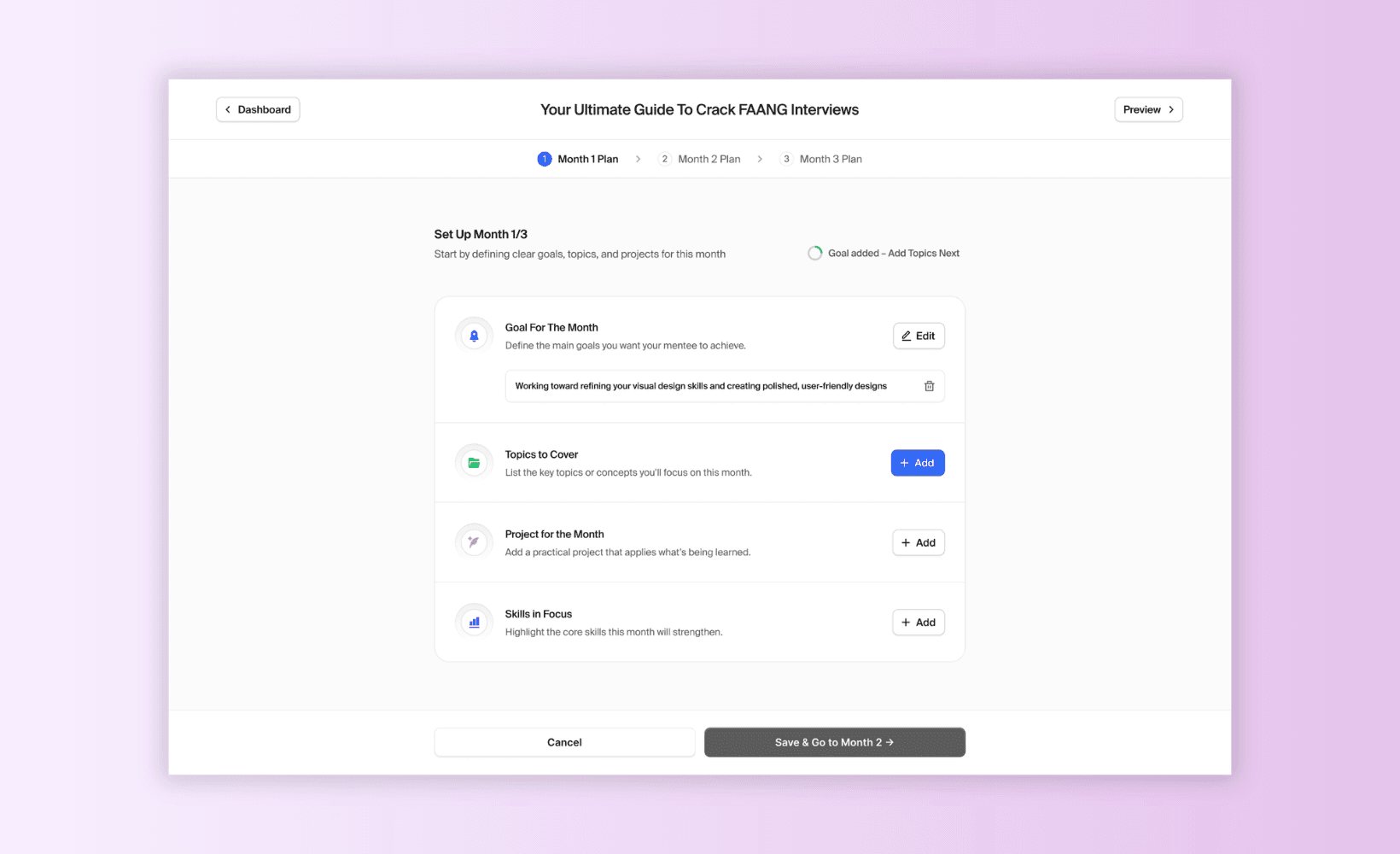
So, the idea behind the Mentorship Plan was to create a one-stop space for mentors where they could build & share structured monthly plans for 1, 3, or 6-month mentorships, consisting of goals, topics, projects, and skills.
This helps mentors conduct more focused trial sessions and enables mentees to make better, more informed decisions about starting their long-term mentorship.
02Understanding the Current Flow
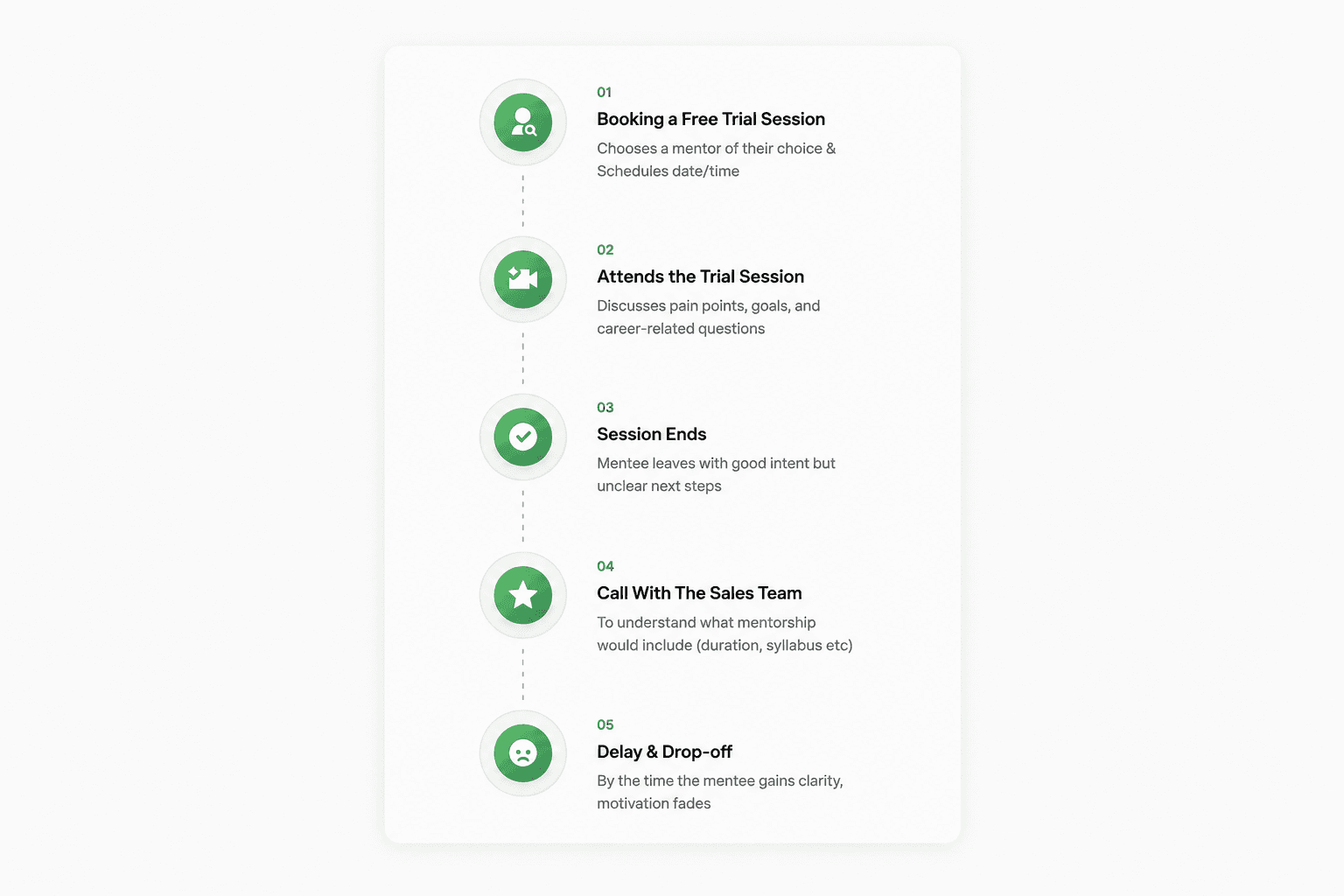
Before the introduction of the Mentorship Plan, the post-trial experience at Preplaced was mostly conversational and manual.
A mentee would book a free trial session with a mentor of their choice, attend the session, discuss their pain points, goals, and career-related questions, and then the session would end.
Mentees often left the trial with good intent but little clarity about what to do next. 🤔
There was no structured way for mentors to turn that discussion into a clear, shareable mentorship plan outlining the steps they would take together to achieve the mentee’s goals.
The next step usually involved talking to the Preplaced sales team to understand what exactly this mentorship would include — the duration, number of sessions, syllabus, and how progress would be tracked.
By the time mentees gained clarity about the plan of action, their motivation to continue with the mentorship often dies. 😮💨
03The Business Impact
This lack of structure is not limited to the lack of clarity for the mentees, but it is hurting our most critical business metric, the Trial-to-LTM (Long-Term Mentorship) conversion rate.
Because most mentees mentioned that the mentor seemed great, but they weren’t fully sure what they were signing up for and paying 50K — 60k for.
Mentors, on the other hand, had no standardized format to present and share during or after the trial session, leading to a poor conversion rate post-trial.
As a result, we were losing the high-intent window — that brief moment after the trial when mentees were most motivated to commit but lacked the clarity to act.
04The Design Hypothesis
Based on these observations and the data collected over time, I believe that introducing a Mentorship Plan feature could help mentees gain clarity and make more informed decisions based on a clear plan of action.
For mentors, it would help in:
• Creating and sharing a structured plan of action with mentees.
• Clearly communicating how they would guide and support the mentee throughout the mentorship.
• Building confidence and transparency in the mentorship process.
In short: When clarity enters the conversation, conversion follows.
05Validating Our Assumptions
Well, while I believed that the missing plan of action was the root cause of the problem, I didn’t want to jump straight into designing a solution.
It was important to go beyond internal assumptions and understand how both mentees and mentors actually experienced the post-trial journey, what drove their decisions, what created friction, and where trust was broken.
Our goals at this stage were to:
• Test our hypothesis that the lack of structure and clarity was the biggest barrier to conversion.
• Uncover hidden behavioral insights that data alone couldn’t reveal.
• Identify what an ideal “post-trial handoff” should look like for both mentors and mentees.
To do this, I conducted a few interviews with both mentees and mentors to hear about their journeys and experiences, not just observe them.
06Research & Insights
To validate our assumptions, I spoke to 10 mentees who attended trial sessions but didn’t convert, and 8 mentors who regularly conduct trials on the platform.
A few screenshots from my conversations with mentors and mentees.
07Insights From Mentee Conversations
Let’s cut to the chase, most mentees had positive feedback about their mentors. They found the sessions insightful, personalized, and worth their time, but they still didn’t purchase the long-term mentorship.
When asked why? Their answers revolved around uncertainty and structure:
“The mentor was really good, but I wasn’t sure how the next sessions would go.”
“I wanted to know how many sessions I’ll get, what topics we’ll cover, and how long the whole thing will take.”
“I thought I’d check with the Preplaced team first they might know the details better.”
This pattern repeated across almost every conversation.
The mentee trusted the person (the mentor) but not the process (the plan).
They wanted clarity around:
• What a 1, 3, or 6-month plan includes
• Session structure and frequency
• Expected outcomes or milestones
• Whether they’d get personalized projects or generic guidance
08Insights From Mentor Conversations
On the mentor side, the story looked very different.
Most mentors were confident in their trial sessions. They focused on understanding the mentee’s goals, offering feedback, and explaining how they could support the mentee.
But when it came to converting that trial into a concrete plan, everyone had their own approach.
“I usually just explain verbally how I can help. I don’t have a standard plan to show.”
“Sometimes I send a Google Sheet if I have time, but it’s manual.”
“If there was something I could fill quickly and share, I’d 100% do that.”
It became clear that mentors didn’t lack intent; they lacked structure.
They wanted flexibility but needed a template or structure to make their offer look more professional and trustworthy.
09A Quick Data Validation
Our internal data supported this pattern:
Star Mentors (Top performers) who manually shared structured plans via Google Sheets or PDFs showed a significantly higher conversion rate compared to those who didn’t.
10Defining the Problem Statement
In the beginning, our team discussions mostly revolved around questions like “How can we increase conversions?” or “How can we sell more LTMs?”
But after uncovering these insights & findings, I reframed the challenge to:
How might we help mentors create and share a clear, structured mentorship plan for trial mentees, so mentees can confidently commit to long-term mentorship?
11Measuring Success
Alright, so with the right problem in mind, we wanted to improve two key business metrics that directly impacted Preplaced’s revenue and mentor engagement:
• Plan Creation & Sharing Rate: Percentage of mentors creating and sharing mentorship plans with their mentees after the trial session. This indicates adoption and active usage of the Mentorship Plan Builder.
• Trial-to-LTM Conversion Rate: Percentage of mentees converting from a free trial session to a long-term mentorship after receiving a mentorship plan.
12Design & The Solution Phase
I wanted this to be one of my best opportunities to create something truly meaningful for mentors. So, I made sure every detail was thoughtfully designed, ensuring that creating and sharing mentorship plans felt simple, intuitive, and effortless.
Now, let’s dive into the designs.
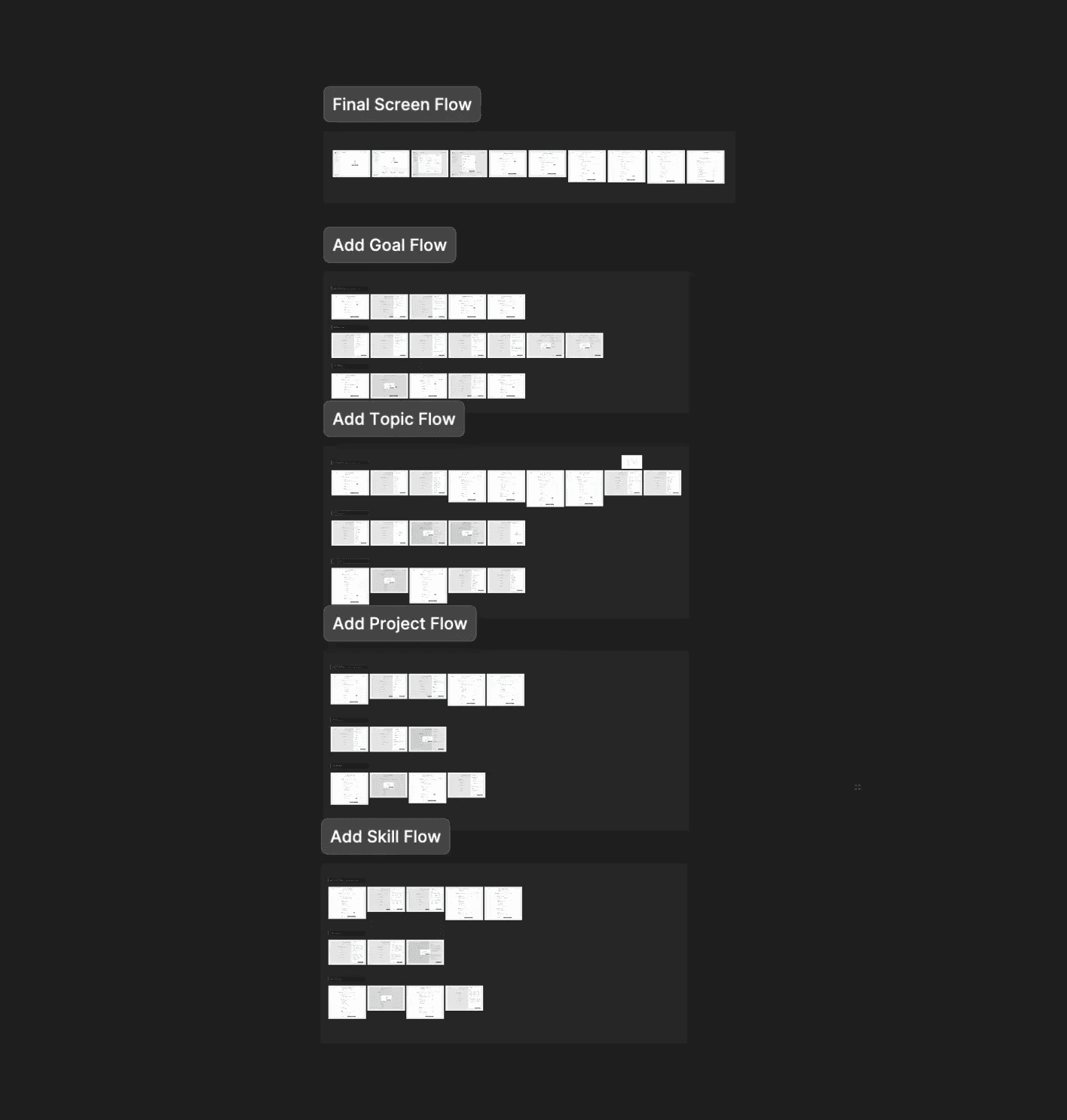
All design iterations and flows can be explored in the attached Figma file in the end.
131. Introducing the Mentorship Plan Tab
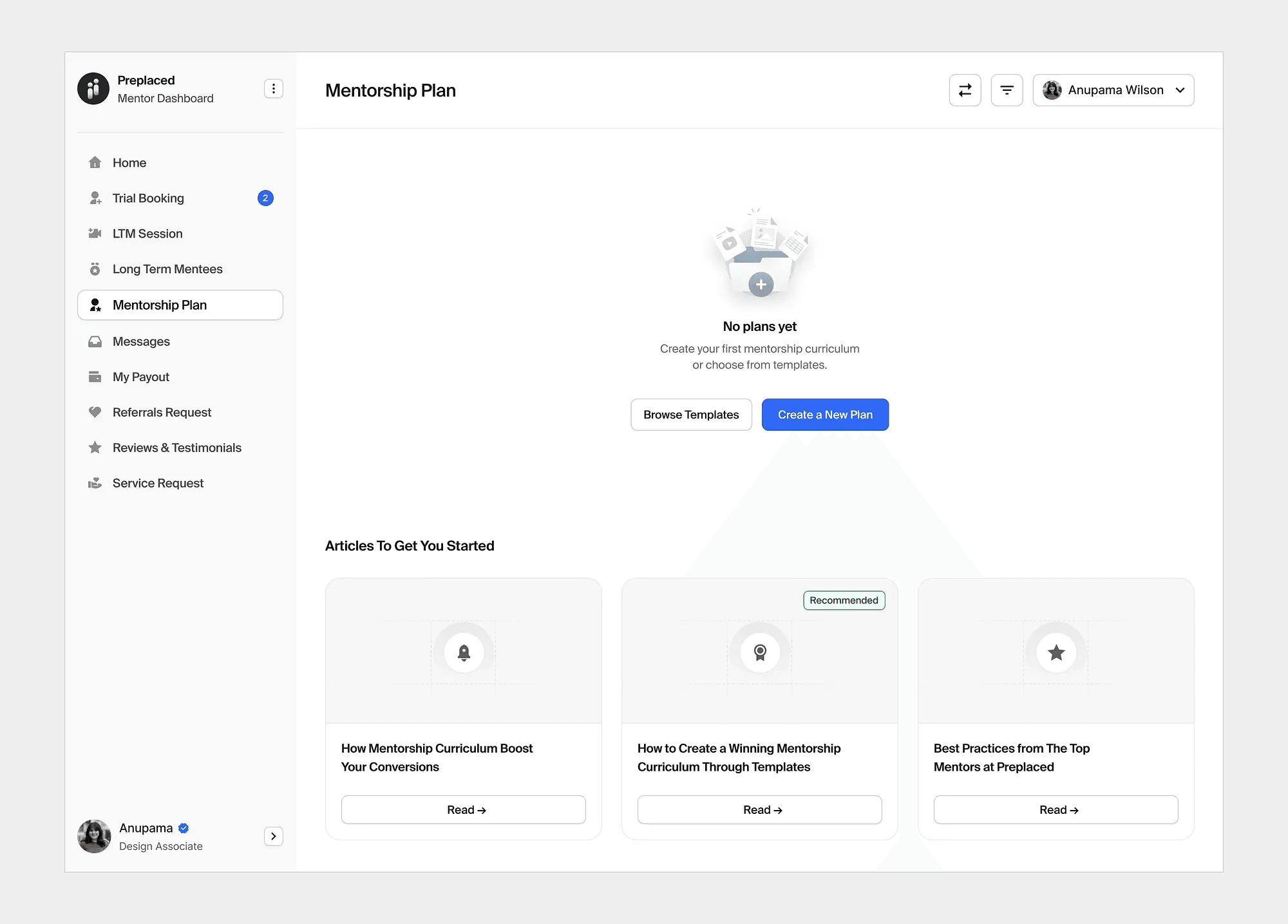
So, First things first, to make sure the Mentorship Plan feature is discoverable and habit-forming, I decided to keep a dedicated “Mentorship Plan” tab inside the mentor dashboard.
This gave mentors a clear entry point to view, create, and manage their plans.
Empty State
To lower the effort barrier, the empty state includes two key actions:
• Browse Templates: For mentors who prefer starting with ready-made structures.
• Create a New Plan: For mentors who want full control and customization.
Additionally, I included a section for Articles to Get You Started, adding self-written short reads on how mentorship plans improve conversions and credibility.
142. Intelligent Template Selection
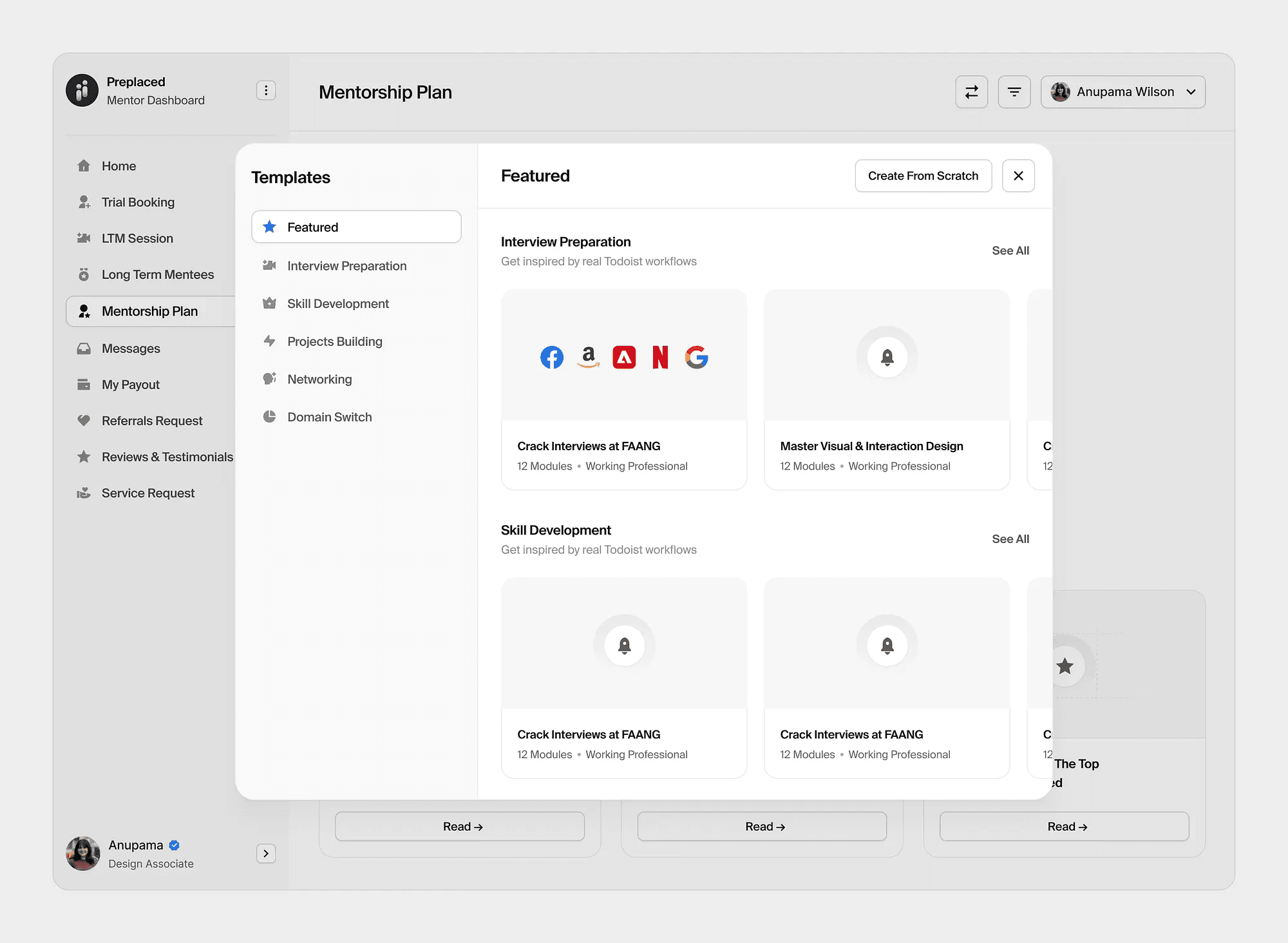
Selecting a relevant template from a vast collection can be overwhelming.
To address this, I decided to only display templates categorized based on historical mentee profiles and goals gathered from the data, such as upskilling, interview preparation, or switching domains.
I also ensure that mentors only see templates related to their specific domain (Product Design mentors will only see templates related to Design). This approach helps improve both adoption and personalization.
153. Designing the Plan Creation Flow ~ Core Experience
When I started designing how mentors would create their mentorship plans, I knew this was the most critical experience of the entire feature.
Iteration 1:
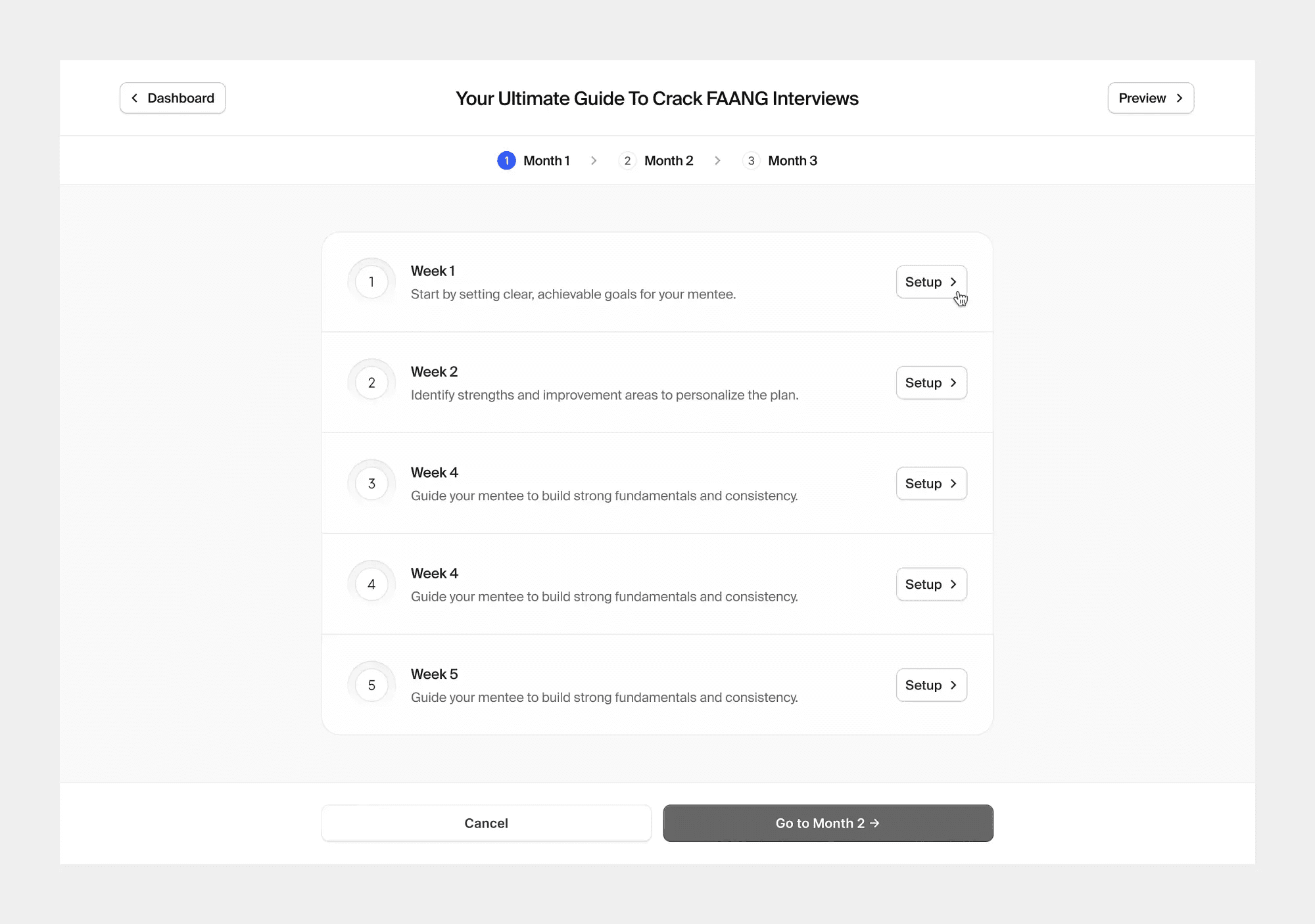
The first Iteration I tried was a week-by-week mentorship planner.
Which mentor needs to fill in, topics and goals for the week?
The goal was to help mentors break their mentorship journey into smaller, actionable milestones.
This approach worked well in theory. But as I spent more time thinking through the flow, a few problems became obvious:
• Mentorships don’t always follow a weekly pattern. Some mentors meet twice a month, others whenever their mentee needs help. The idea of locking everyone into a weekly plan just didn’t fit the reality of how mentorships actually work.
• It also failed to scale. In longer plans(i.e, 6 months), the layout would turn into endless lists of weeks, making the setup feel repetitive and heavy.
Iteration 2:
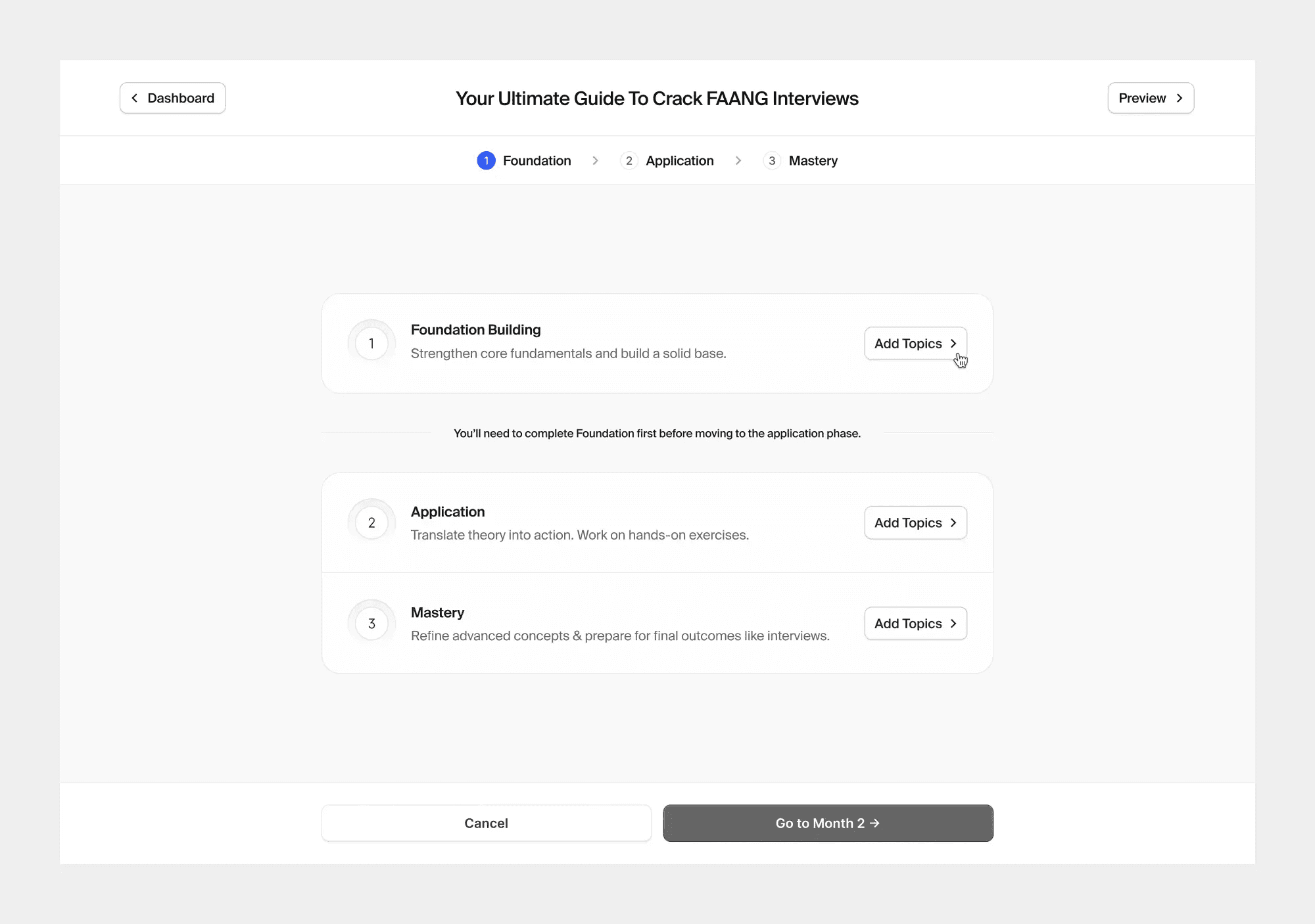
After realizing that a week-by-week planner was too rigid, I explored a phase-based approach to mentorship.
Instead of tracking time, this model focused on learning depth, breaking the journey into three natural stages: Foundation → Application → Mastery.
The idea was simple: not every mentorship runs on the same schedule, but almost every mentorship grows in this order.
Again, there were a few fundamental issues with this approach:
• Preplaced’s entire system, from payments to progress tracking, is built around monthly mentorship plans (1, 3, or 6 months). Introducing a phase-based format creates a disconnect between what mentors built and how the platform measures outcomes.
• From the mentee’s perspective, “Foundation” or “Application” didn’t communicate how long each stage would take.
• What was “Foundation” for one mentor could be “Application” for another, making the structure inconsistent and hard to maintain at scale.
16Final Iteration:
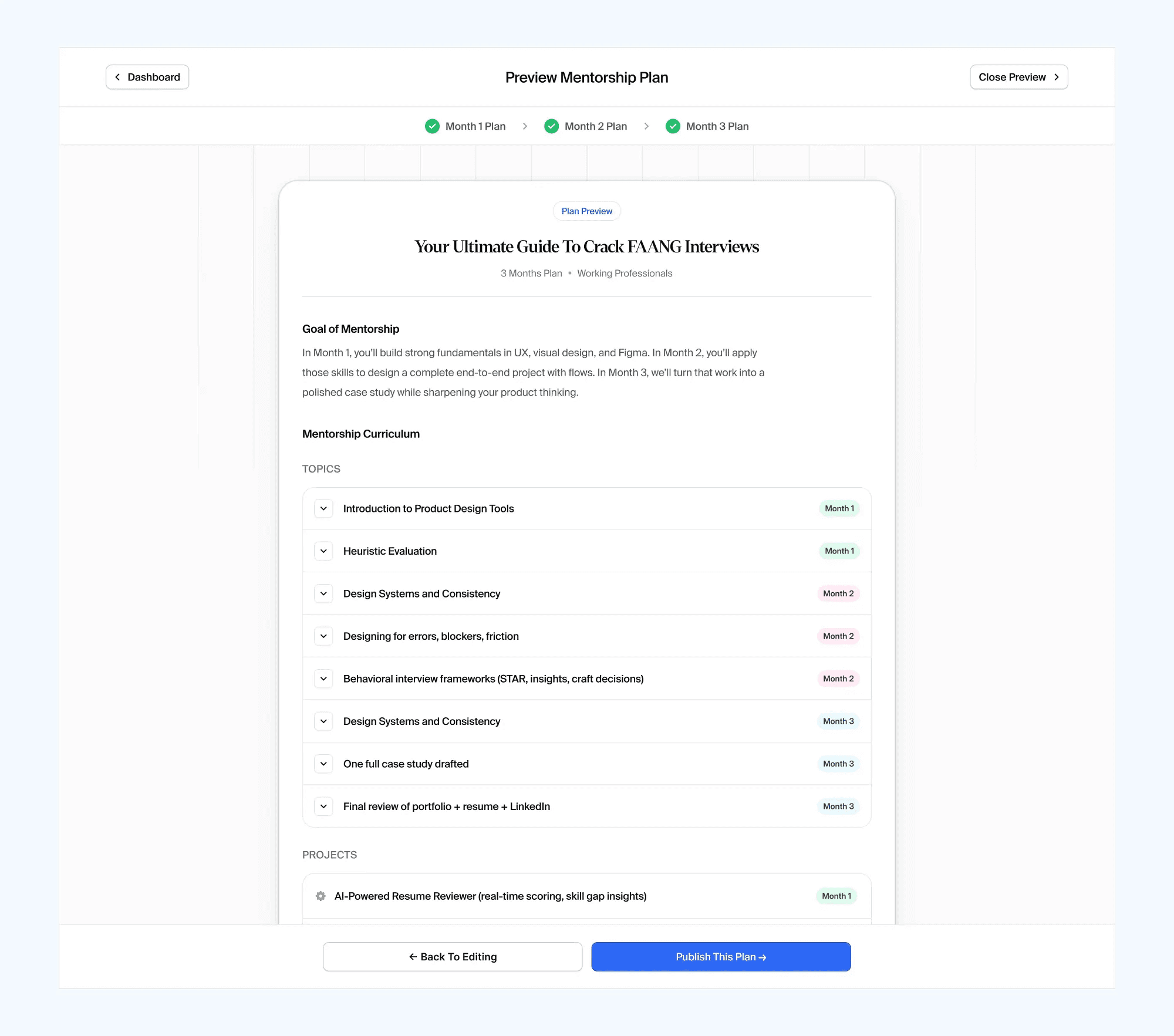
After multiple explorations, I arrived at a structure that felt natural to mentors, clear to mentees, and scalable for the platform: a month-by-month mentorship planner.
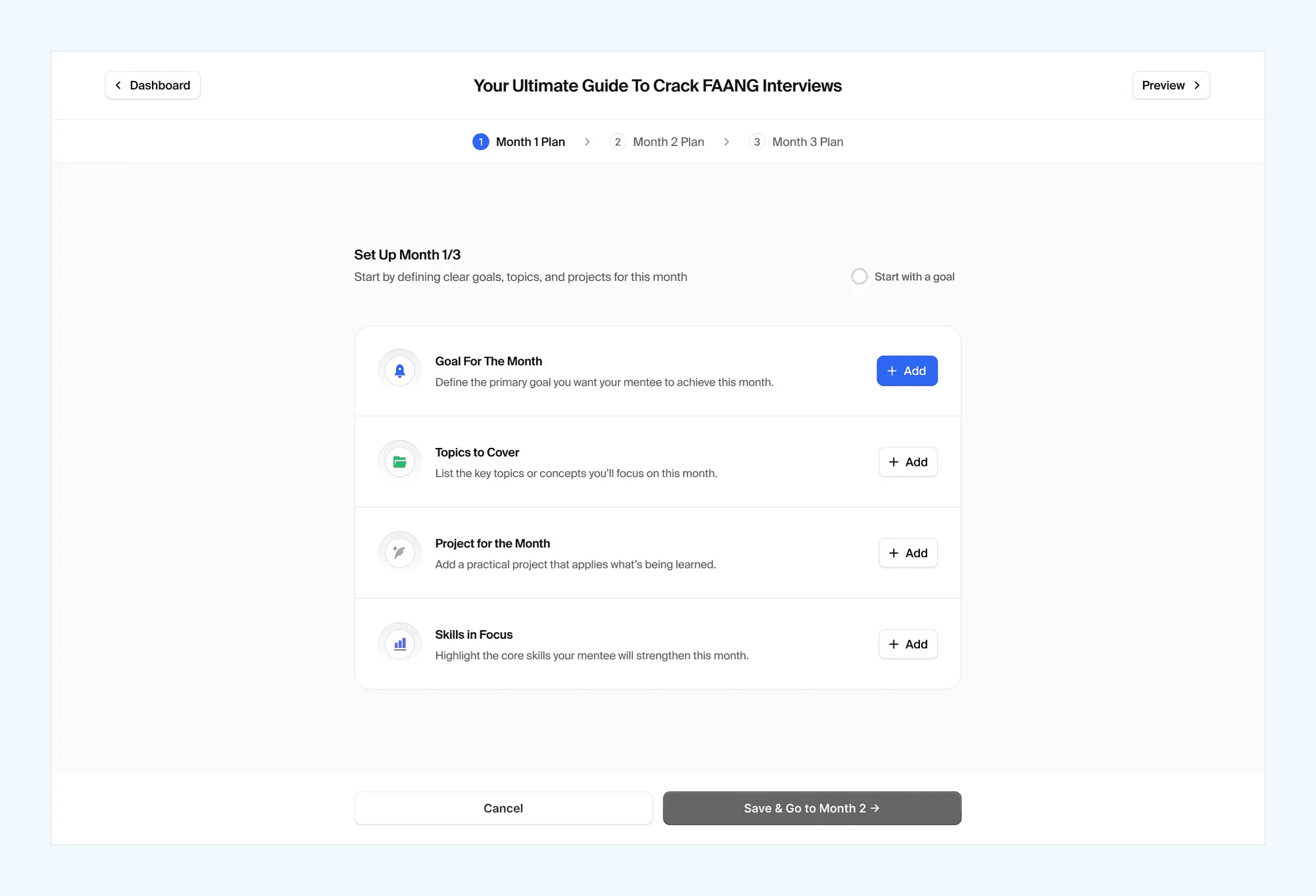
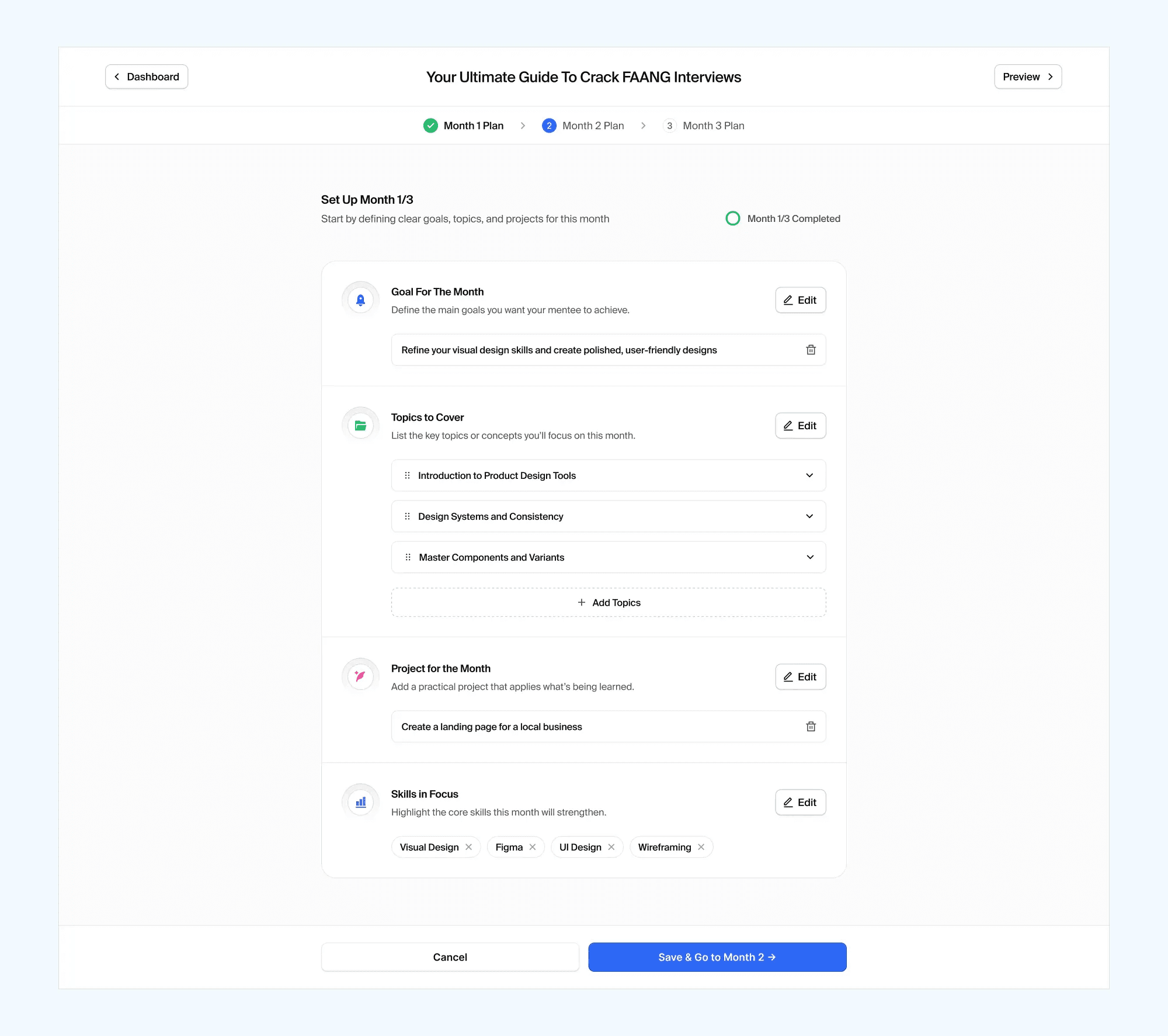
Instead of forcing mentors to plan the entire 3–6 month journey at once, the system guides them to create one month at a time, keeping the process lightweight, modular, and consistent.
17Why This Approach Worked
• Progressive Creation: Instead of asking mentors to plan everything all at once, the month-by-month approach broke the process into smaller, more manageable chunks.
• Consistent mental model: Each month follows the same 4-part structure: Goal → Topics → Project → Skills. Once mentors understood this pattern, creating plans became second nature. It’s simple, predictable, and scalable across mentorships.
• Designed to scale both behaviorally and operationally
The same layout works for 1, 3, or 6-month mentorships. Mentors can reuse plans easily, and mentees get a familiar rhythm of progress every month, keeping both engagement and conversion high.
18Design Details & Edge Cases
Smart Search Assistance
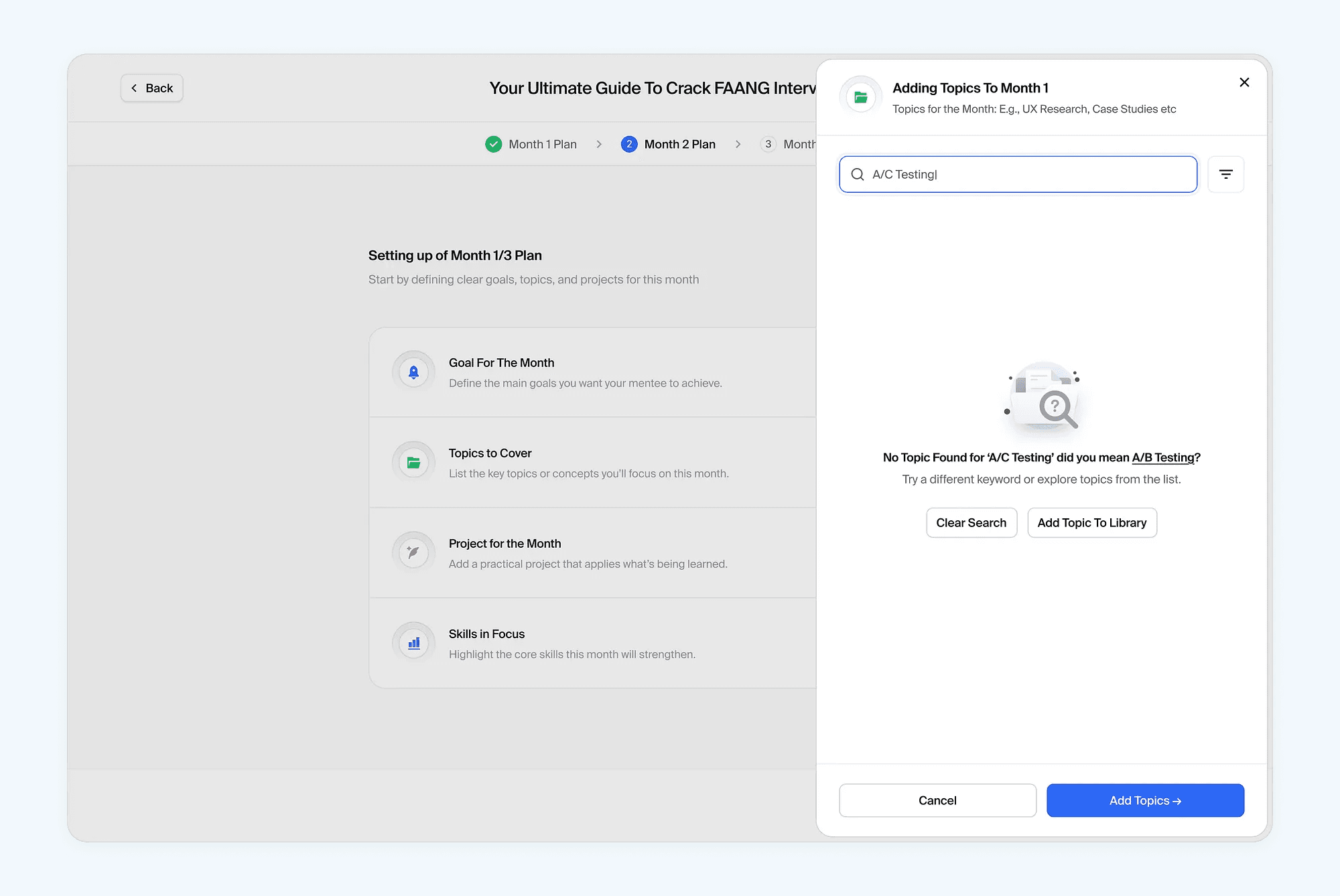
When mentors mistyped a topic (e.g., “A/C Testing”), the system suggested the closest match (“Did you mean A/B Testing?”) instead of showing an empty state, thereby reducing friction and keeping the flow smooth.
Custom Topic Addition
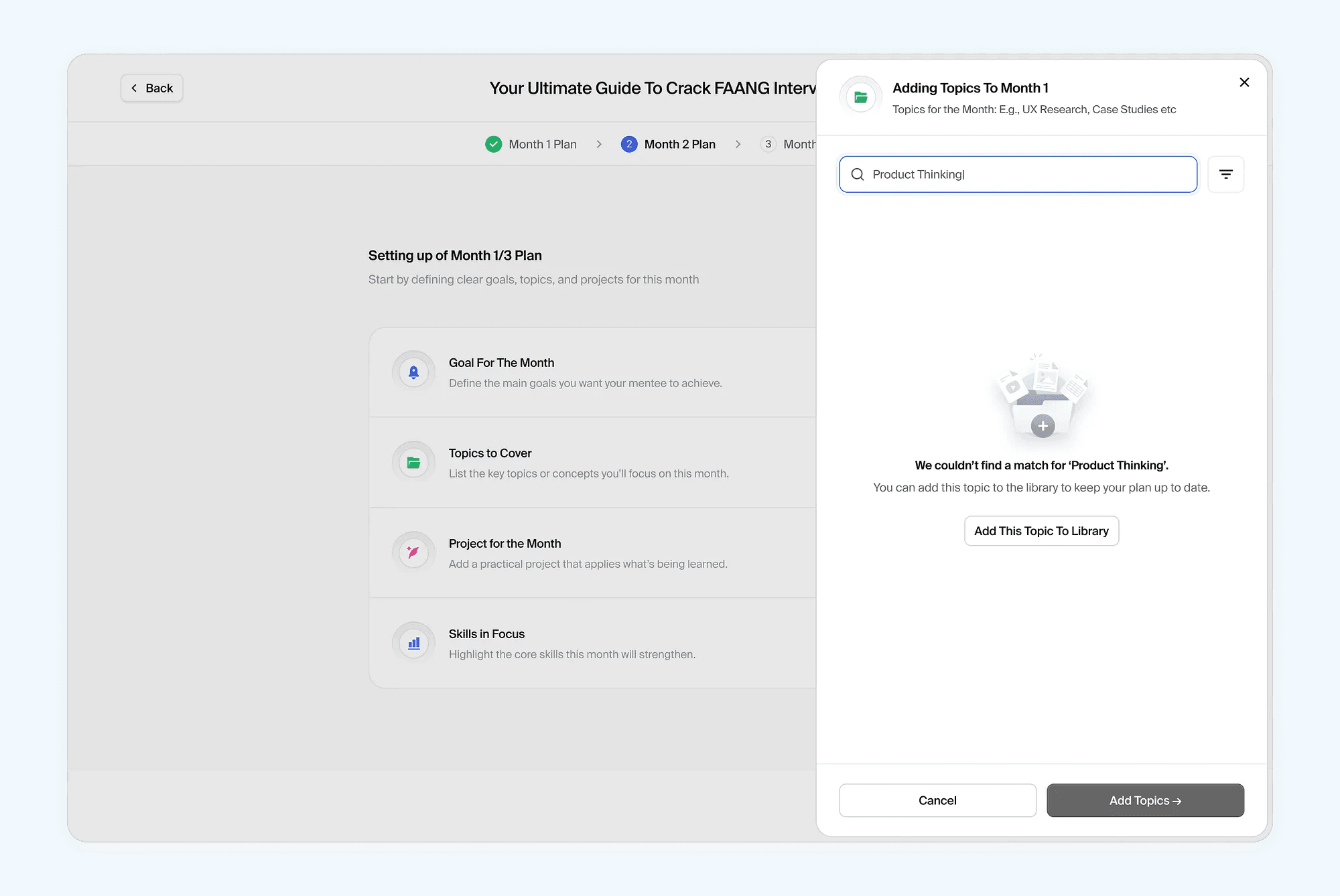
If no match existed (especially due to gaps in our third-party topic source), mentors could instantly add that topic to the library, keeping the experience flexible and continuously improving the content set.
Unsaved selections:
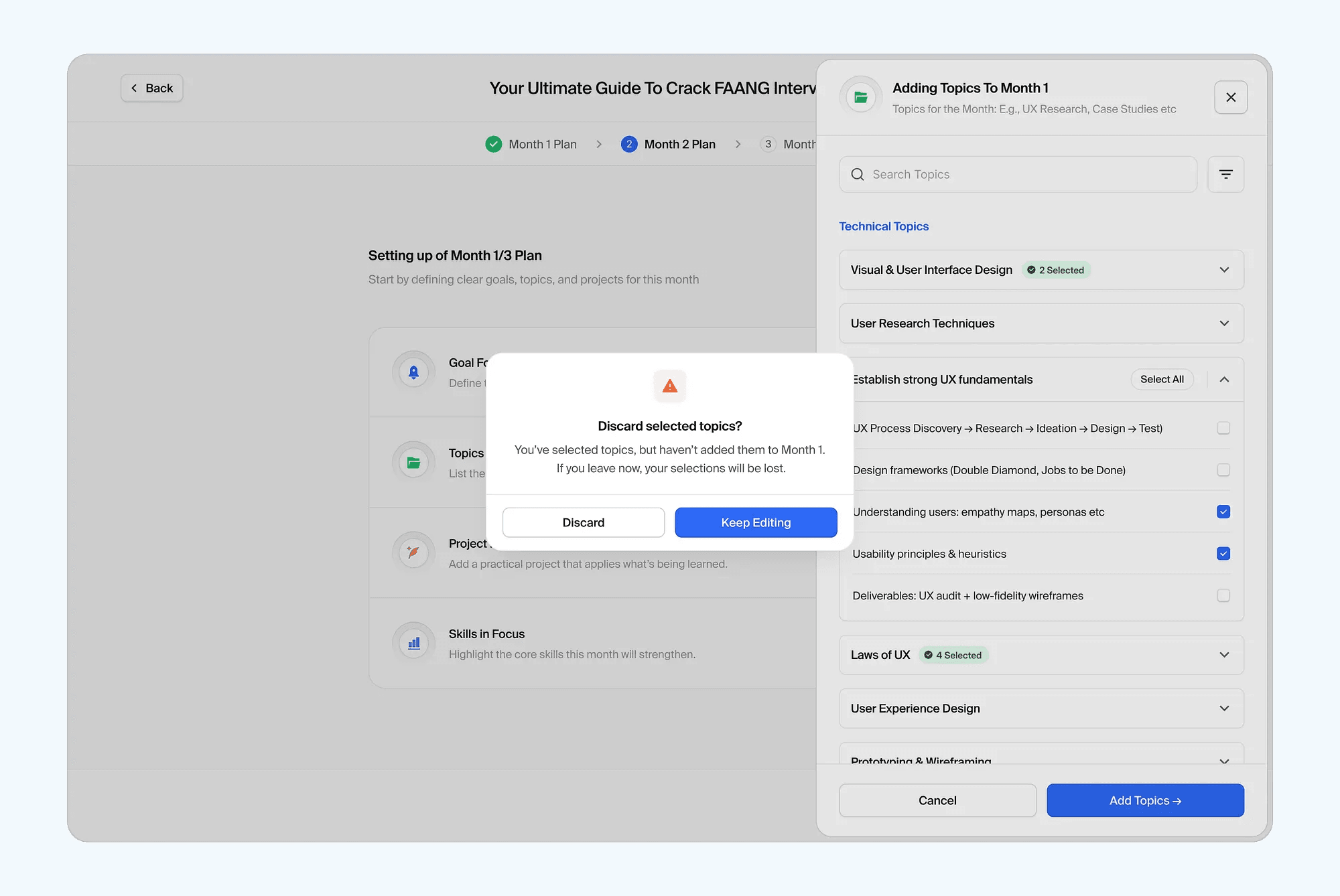
If mentors selected multiple topics but clicked outside the sheet, a subtle error state appeared, prompting them to save before exiting, preventing accidental data loss.
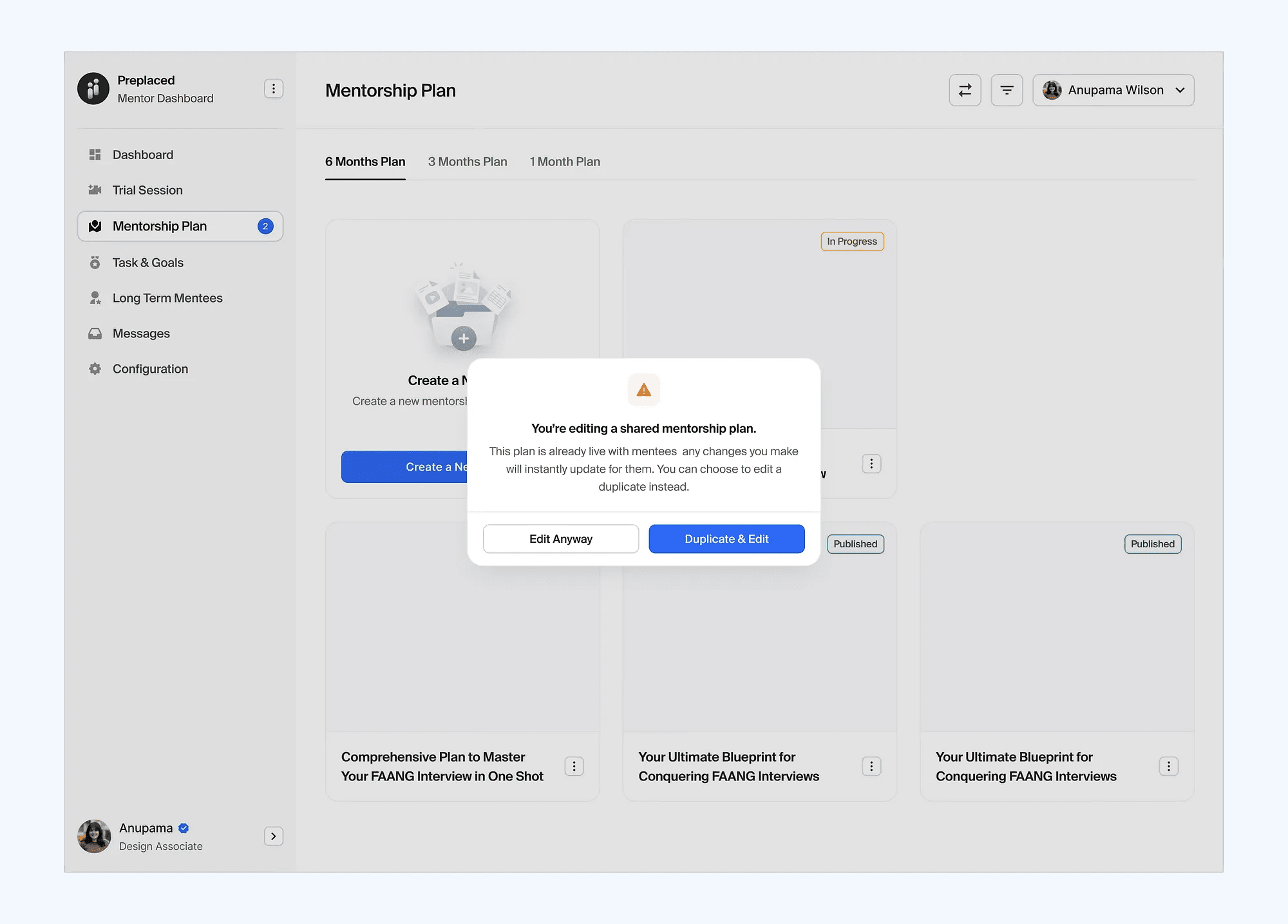
Conflict Handling in Shared Plans:
To prevent accidental overwrites, I added a smart warning system for shared plans. When mentors edit a plan that’s already been shared with mentees, they get a clear choice:
19Integrating Plan Sharing Into Everyday Actions
Designing the Mentorship Plan Builder was only half the problem.
For it to drive real business impact, mentors needed to use it often, ideally at the right moments when mentees were most engaged.
20The Important Key Touch Points
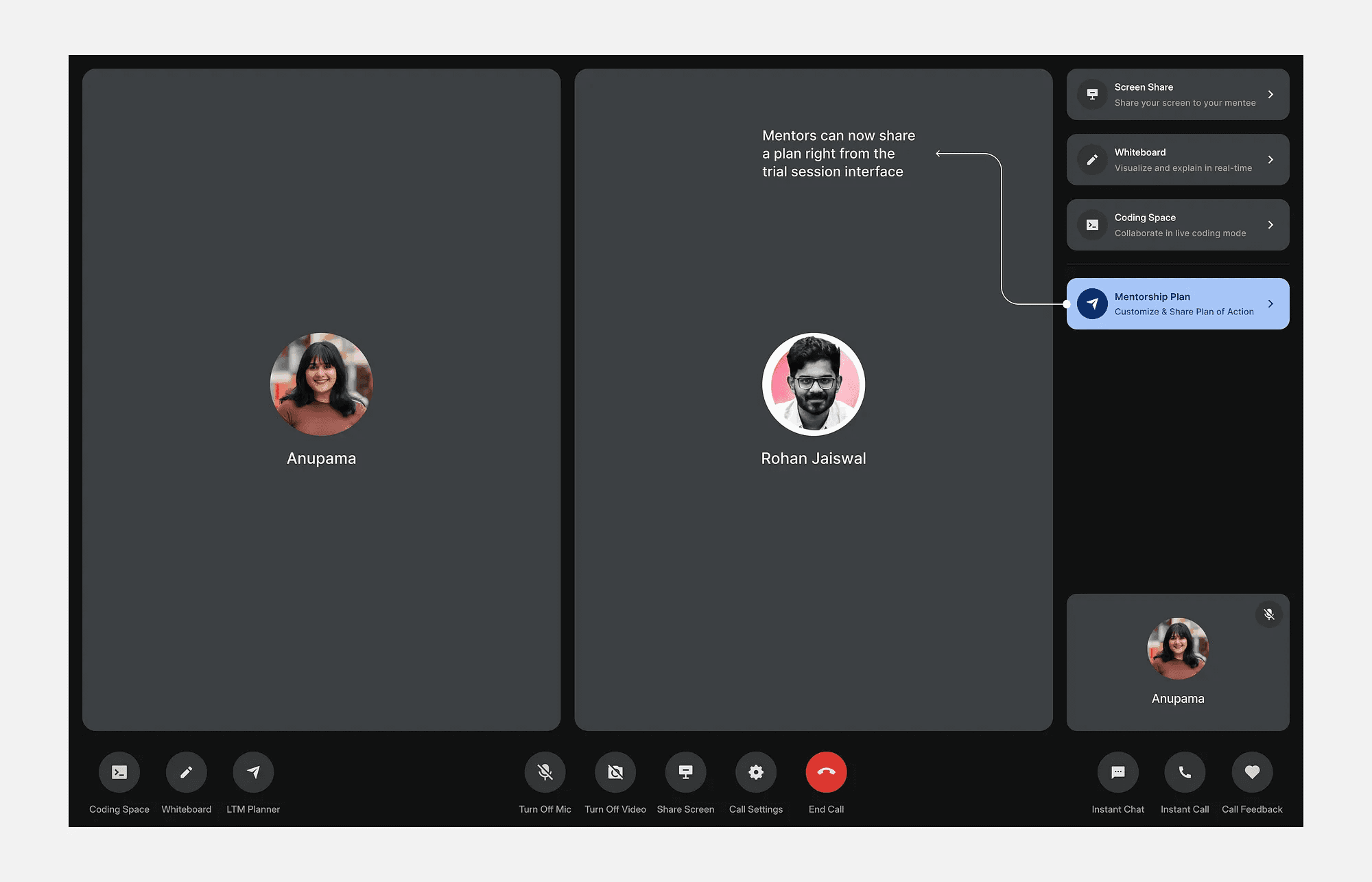
During the Trial Session:
I have added a “Share Plan” quick action right in the Trial Session Interface, allowing mentors to pick or create a plan on the spot and share it with the mentee.
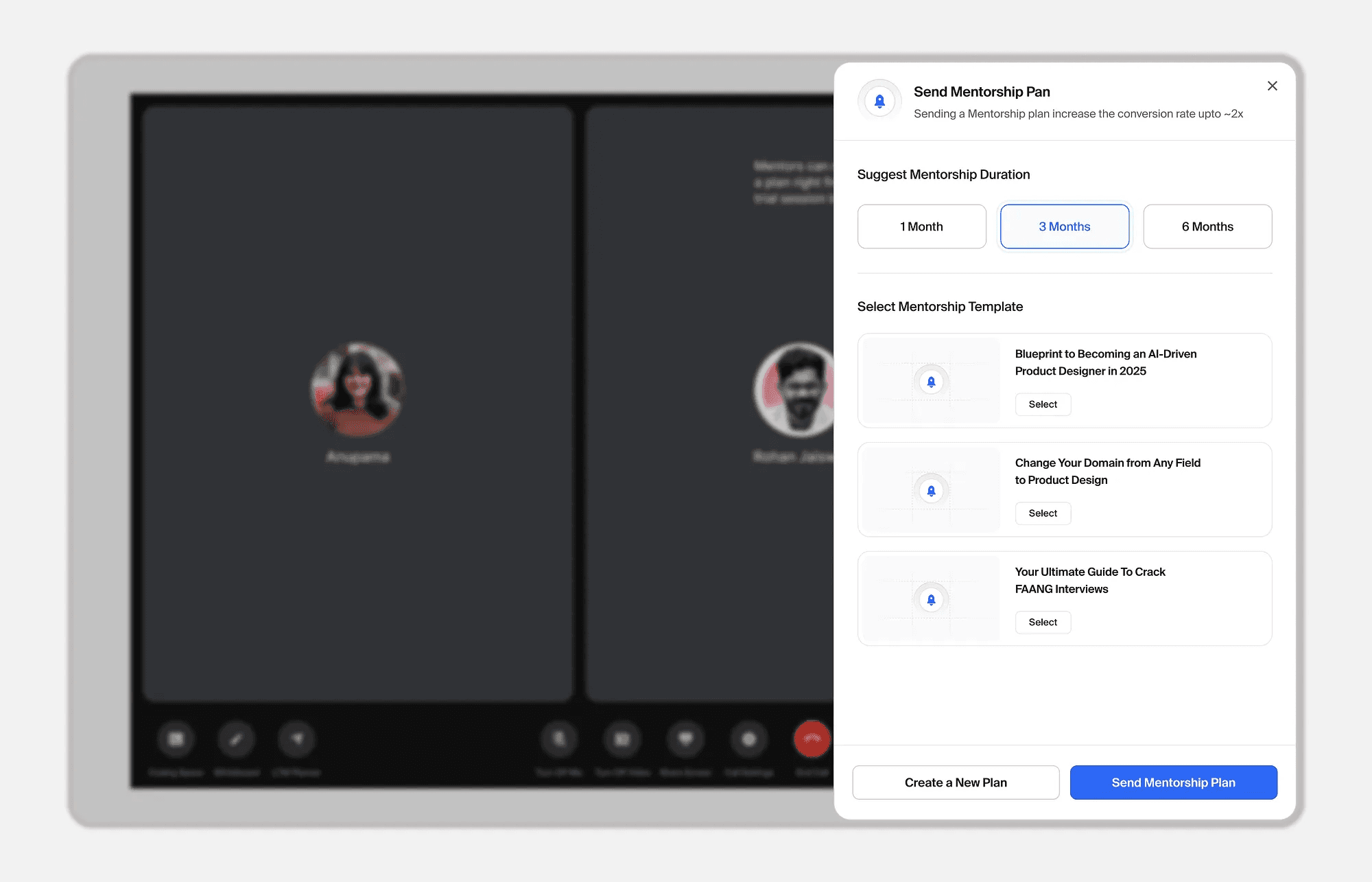
At the End of the Trial Session:
If a mentor doesn’t share a plan during the session, a quick prompt appears once it ends, reminding them to send one while the mentee’s interest is still high.
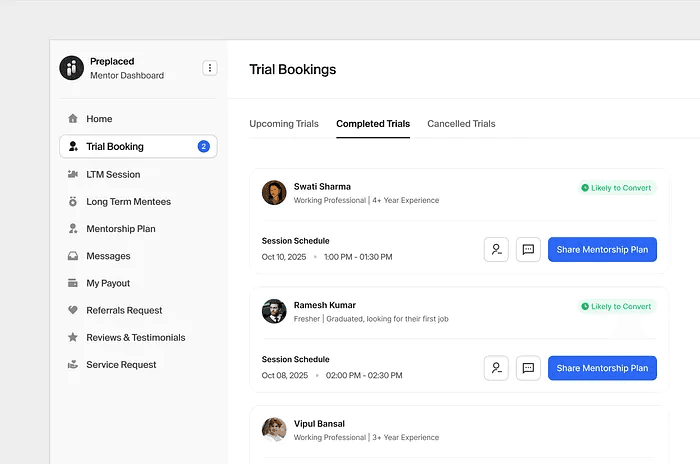
Under a Completed Trial Menu:
Mentors can also share plans directly from the trial completion historyview, making it easy to follow up later without hunting for the mentee.
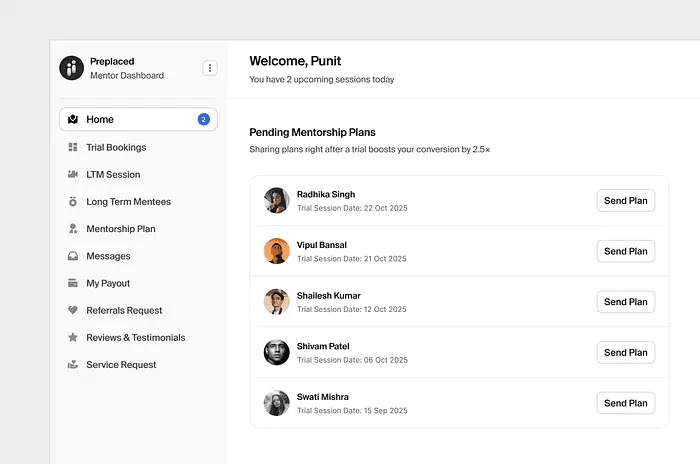
Mentor Dashboard Home Tab:
Added a new “Pending Mentorship Plans” section that shows mentors which mentees have completed a trial but haven’t received a plan yet, making follow-ups effortless and visible.
21Impact
I didn’t expect instant conversion lift right after launch; the first milestone was adoption. The Mentorship Plan Builder was designed to change behavior first and impact business next.
• Within the first month, over 90% of active mentors created at least one plan, a clear sign that the system fit naturally into their workflow.
Only after mentors became comfortable with creating and sharing plans did we start measuring downstream impact.
• Around 20 days post-release, I ran a cohort analysis comparing mentees who received a mentorship plan versus those who didn’t.
• Before launch, the average trial-to-LTM conversion rate across domains was around 22–24%. After releasing the Mentorship Plan, that number rose steadily to 33–36% a 50% increase in actual conversions.
• This uplift wasn’t a one-time spike; it held consistently across product, design, and data mentorship domains.
22Learning & Way Forward
Building this at a startup meant everything moved really fast, and decisions often had to be made with imperfect data.
If I had more time, I’d have loved to run deeper usability tests, track long-term plan effectiveness, and explore mentor-side analytics to visualize mentee progress.
Still, this project taught me a lot about balancing speed with depth, how to ship something valuable quickly, validate it in the real world, and keep iterating based on usage rather than assumptions.
23And… That’s a wrap!
I hope you found this case study useful and insightful. Feel free to reach out on any social platform if you have questions. I’d be more than happy to chat. You can find me on Twitter and LinkedIn for any further discussion.
If you’d like to explore the iterations and detailed user flows for this project, you can view them in the Figma file here: